Travellers planning a Peloponnese trip often narrow it down to two names: Monemvasia, the medieval castle town tethered to the mainland by a short causeway, and the Mani, the stony middle finger of the Peloponnese studded with fortified tower houses. Both sit in Laconia, both reward slow travel, and both are reachable from Athens in roughly the same half-day. But they offer different rhythms, different costs, and different kinds of golden hour. This guide lays out the practical differences so you can choose the one that suits your time, or work out how to fit in both.
What each place actually offers
Monemvasia is compact and photogenic: a single walled town built into a rock, cobbled lanes, a cliff-top church, and a handful of tavernas and guesthouses inside the fortress walls. Most visitors cover the old town on foot in three to four hours, including the climb to the upper citadel, which takes about 40 minutes round trip and is best attempted before 10am in summer to avoid the heat. It is a place you look at and wander through rather than explore in depth over multiple days.
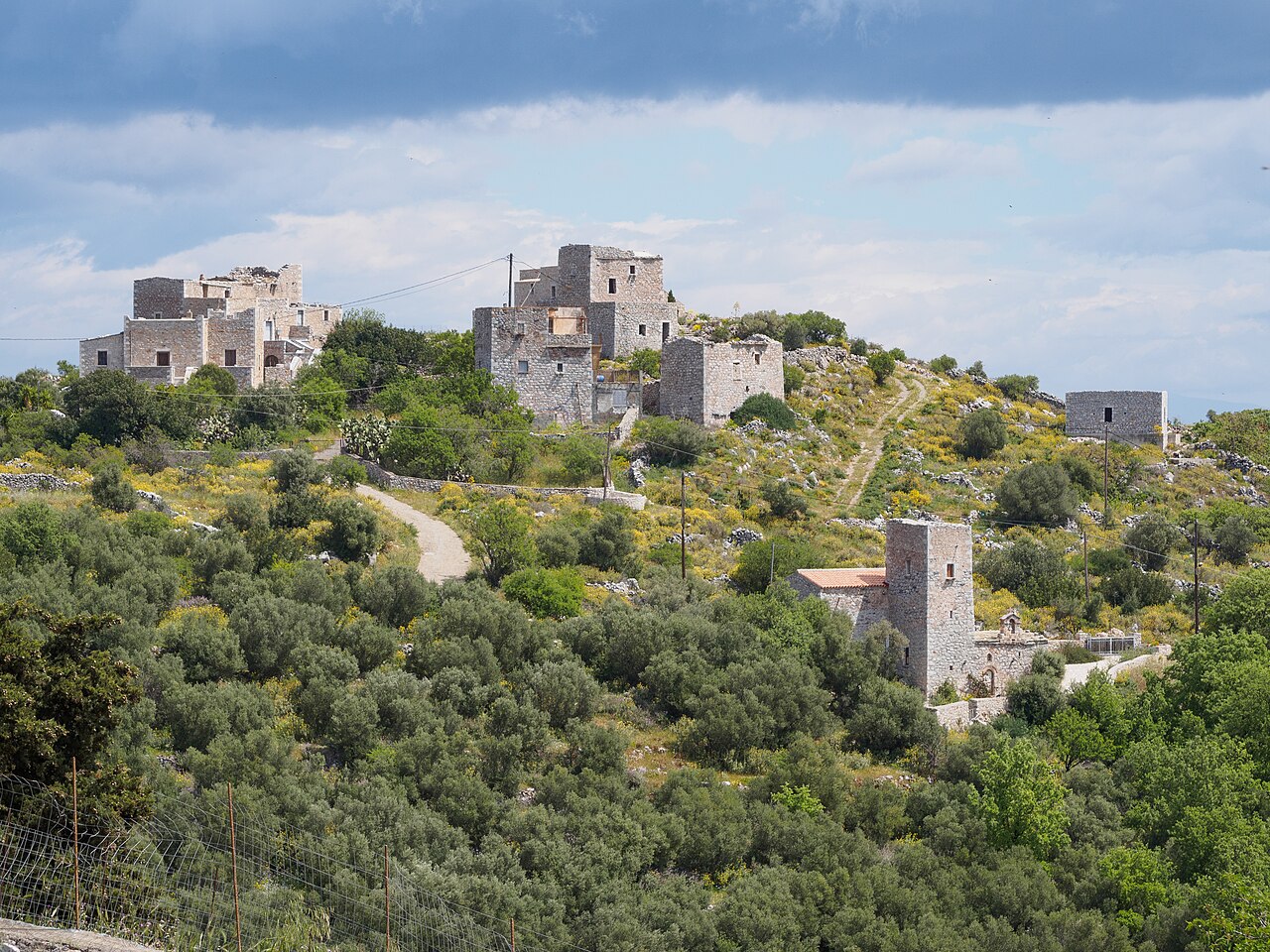
The Mani is larger and more varied: a 70-kilometre spine of villages, gorges, and stone beaches running from Areopoli down to Cape Tainaron. Dozens of settlements, from Vathia's abandoned tower clusters to the fishing hamlet at Gerolimenas, are scattered across Inner and Outer Mani. Instead of one sight, you get a landscape: feuds and towers dated in stone lintels, roads counted in hairpin curves, and villages that feel austere rather than postcard-pretty. A proper visit needs at least two full days of driving and walking, ideally three.
Distances and how long each needs
Monemvasia sits about three and a half hours by car from Athens, roughly 320 kilometres via the Moreas motorway, with tolls totalling around 20 euros each way. It works well as a one or two-night stop: one night to see the castle at sunset and dawn, a second if you want to add the nearby beaches or Mystras.
The Mani starts around Gythio or Areopoli, about four hours and 260 kilometres from Athens, and genuinely rewards two to three days. A single day gets you a rushed loop of Areopoli, the Diros caves, and one or two villages. For a fuller picture, the two-day Mani road trip from Areopoli or the longer three-day loop covering the whole peninsula are better benchmarks for planning.
Cost comparison
Monemvasia, being a concentrated tourist draw, runs slightly higher per night for accommodation inside the old town, typically 90 to 160 euros for a double room in high season, with meals in the walled tavernas at the upper end of regional prices because everything is carried in by hand or small vehicle.
The Mani spreads spending across more villages and price points. A tower-house stay in Areopoli or a simple room in Gerolimenas can run from 50 to 100 euros a night outside August, and food is generally cheaper away from the main squares. For a fuller breakdown, see what it really costs to visit the Mani, and for where to base yourself, where to stay in the Mani covers Areopoli, Limeni, Gerolimenas and tower conversions.
If you have one night only: pick Monemvasia for a self-contained, walkable evening and sunrise. If you have two nights or more and enjoy driving, the Mani gives more varied days. Combining both needs at least four nights total, since they sit roughly two hours apart by car via Sparti.
Driving between the two
It is entirely possible to do both in one trip. From Monemvasia, the drive to Areopoli via Sparti takes about two hours, covering roughly 130 kilometres of mostly good road, with the final stretch into the Mani narrowing into the peninsula's characteristic curves. Many travellers slot in Mystras on the same leg, since it sits almost directly between the two. If you are weighing whether a car is necessary at all, car or no car in the Mani explains why public transport struggles to cover the peninsula's scattered villages, whereas Monemvasia's old town itself needs no car once you arrive.
Best season for each
Monemvasia is busiest from June through September, when the causeway car park fills by mid-morning and the old town's narrow lanes get crowded by lunchtime. Spring (April, May) and early autumn (late September, October) bring milder heat and thinner crowds, better for the citadel climb.
The Mani handles heat differently: its stone beaches and shaded gorges offer relief even in August, though inland villages can feel baked by afternoon. Winter transforms it rather than closing it down, with wild seas at Cape Tainaron and quiet, atmospheric villages, as covered in Mani in winter. For a month-by-month view of both regions, the season-by-season guide to the Mani is a useful companion.
Which to choose, practically
Choose Monemvasia if your trip is short, you want one dramatic set-piece rather than a driving itinerary, and you are comfortable with a touristic but genuinely beautiful walled town. Choose the Mani if you have more days, enjoy self-driving past dry-stone walls and tower villages, and want a region that still feels proud and austere rather than polished for visitors. If your itinerary allows it, pairing a one or two-night stop in Monemvasia with three days deeper into the Mani, via Areopoli and down to Vathia at the end of the road, gives a fuller sense of Laconia's range: castle town and tower peninsula, ten minutes apart in character even if two hours apart by road.