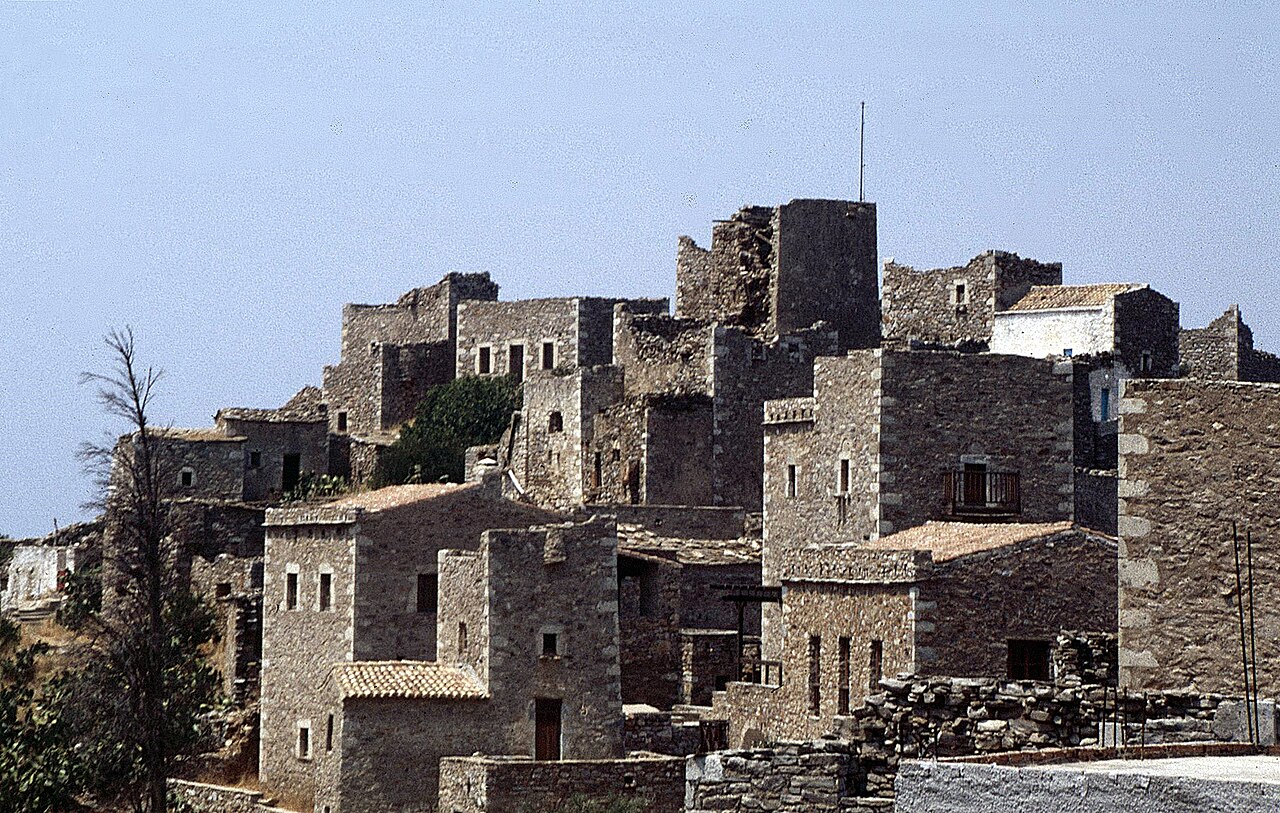
The road from Areopoli narrows as it drops toward the sea, and after roughly 20 minutes of curves (around 19 kilometres) the first towers of Vathia appear stacked on a spur of rock above the Ionian. There is no mistaking the place: dozens of stone tower-houses, three and four storeys tall, built close enough that a feud between neighbouring families could be fought window to window. Vathia is often called the most dramatic of the Mani's tower villages, and from a distance, especially at golden hour, it earns the description without needing embellishment.
Why the towers were built
Mani families built upward rather than outward because land was scarce and trust between clans scarcer still. Tower height signalled power: a family that could afford to add another storey was a family that could defend it. Vathia's towers date mostly from the 18th and early 19th centuries, a period when vendettas between local clans could last generations and were settled, when settled at all, by elders rather than courts. The result is a village shaped less like a settlement and more like a fortress turned inward on itself, towers pressed shoulder to shoulder along a ridge with almost no flat ground between them.
Walking the village
Vathia has no real centre in the conventional sense: a handful of narrow lanes, some barely a metre wide, thread between the towers and dead-end at the cliff edge. Most of the structures are unrestored and closed, their roofs gone, windows empty, and interior floors collapsed. A few towers have been carefully restored as guesthouses, which gives the village an odd, half-lived-in quality: beautifully kept stonework beside a ruin missing its roof. Walking the full loop takes 20 to 30 minutes at an unhurried pace. Good shoes matter here: the paths are uneven cobble and loose stone, and there is no handrail near the drop toward the sea.
Vathia has no petrol station, pharmacy, or ATM. The nearest services are in Areopoli, about 19 km north. Carry water, especially between June and September, since there is little shade among the towers.
The view and the light
Vathia's real draw is less the architecture itself than its position: the village sits on a rocky knoll with the sea on two sides and the bare, terraced slopes of the Mani behind it. Late afternoon light turns the pale stone gold and throws long shadows between the towers, which is why most visitors time their stop for the two or three hours before sunset. Midday light is flatter and the heat more punishing, with little cover anywhere in the village. A small parking area sits just below the village on the main road; from there it is a short uphill walk of a few minutes to reach the towers.
What to see nearby
Vathia sits close to several other Deep Mani landmarks worth combining in a single day. Gerolimenas, a small harbour village about 7 km further south, has a handful of tavernas with sea-view tables, useful for lunch or an early dinner. The cave of Diros, roughly 20 minutes back toward Areopoli, offers boat tours through underground lakes, though queues can build in July and August and it is worth checking the day's schedule before setting out. Further south still, the road continues toward Cape Tenaro, the traditional end of mainland Greece, where a lighthouse marks the final stretch of track past Roman mosaic ruins.
Practical notes
Vathia is reachable only by car or organised tour; there is no regular public bus service to the village itself. The drive from Areopoli takes about 25 minutes on a paved but winding road, and from Gythio, the nearest larger town, allow around an hour. There is no entry fee and no fixed opening hours, since the village is an open site rather than a museum, though the handful of restored guesthouses operate on their own booking calendars. Spring (April to early June) and early autumn (September to October) bring milder temperatures and clearer light than the height of summer, when the bare hillside offers little relief from the heat.