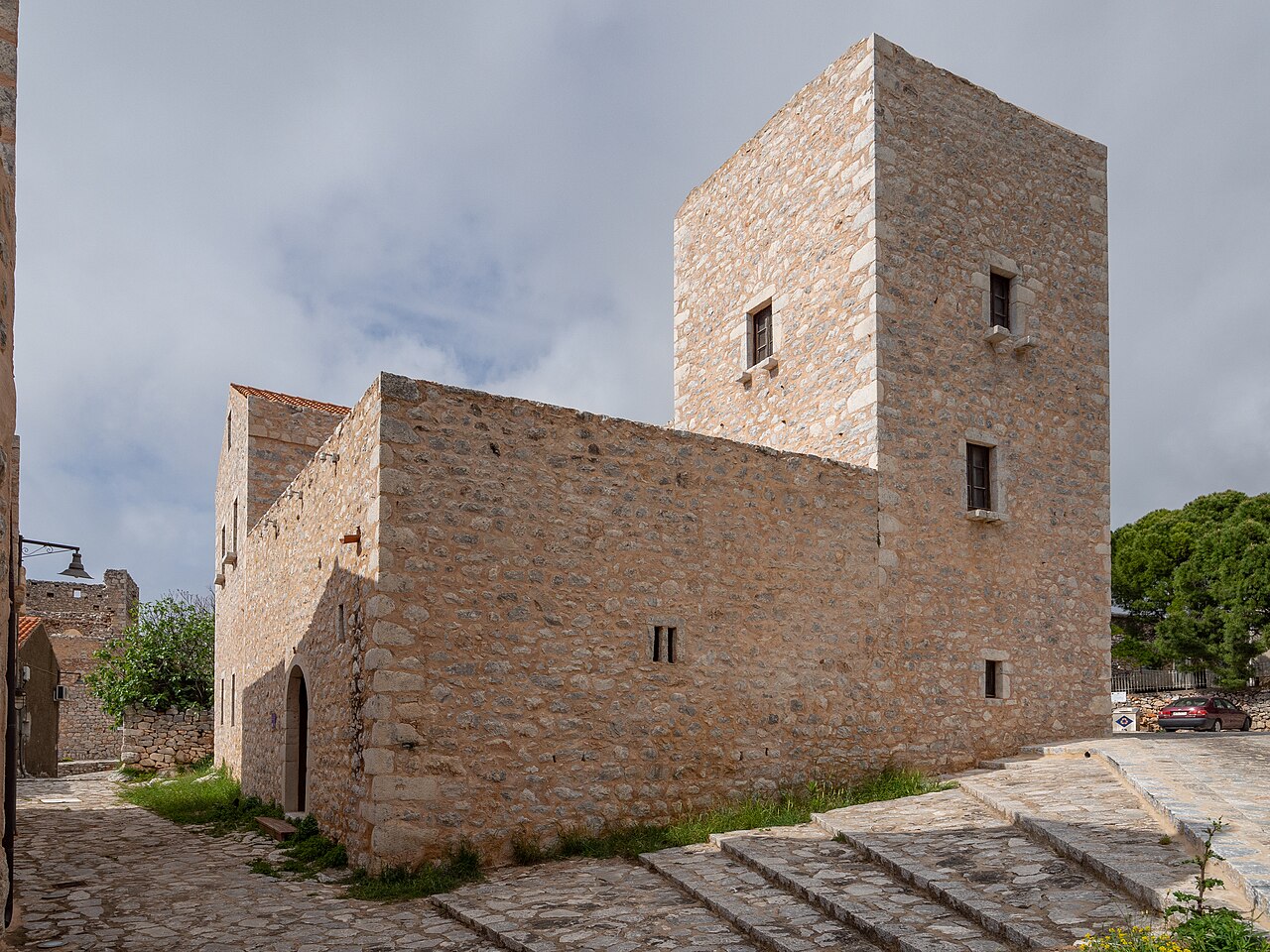
Areopoli sits at the hinge between the wooded Outer Mani and the bare, sun-struck Inner Mani, which is why almost every itinerary through the stone villages begins or ends here. The town was named after Ares, god of war, a fitting patron for a settlement built by clans who raised square tower houses not for show but for defense against each other. Today the old quarter is small enough to cross on foot in fifteen minutes, yet dense with enough history, food and lodging to justify a full day before pushing further south.
Orienting yourself in the old town
The main square, Plateia Athanaton, holds a statue of Petrobey Mavromichalis, the Maniot chieftain who declared the uprising against Ottoman rule here in March 1821. From the square, Kapetan Matapa and the surrounding lanes fan out through the tower settlement: three- and four-storey stone houses, some restored as guesthouses, others still roofless shells. The church of the Taxiarches, with its carved marble bell tower, is worth the five-minute walk from the square; look for the relief panels depicting zodiac signs and saints side by side, a detail locals point to as evidence of the Mani's slow, reluctant Christianization. Most of the old town can be walked in under an hour, but allow two if you plan to stop for coffee and photographs at golden hour, when the stone genuinely glows.
Practical basics: parking, timing, season
Areopoli has no train or bus station beyond a small KTEL stop with a handful of daily connections to Sparti and Athens; most visitors arrive by car, and that remains the only realistic way to continue into Inner Mani. Free parking is available on the approach roads into town, a short walk from the square; the old town itself is largely pedestrian or too narrow for comfortable driving. Spring (April to June) and early autumn (September to October) bring the most comfortable walking temperatures, while July and August push well past 30°C by midday, making a morning start essential. For a broader sense of when conditions suit your plans, the site's season-by-season guide to the Mani breaks down what to expect month by month.
Most tavernas and shops in Areopoli close for an afternoon break between roughly 16:00 and 19:00, a holdover from the pre-tourism rhythm of the town. Plan lunch before 15:00 or dinner after 19:30, and check the day's opening hours for anything you specifically want to visit, as small museums and churches keep irregular schedules outside peak season.
Day trips from Areopoli
Areopoli's real value is as a hub. The Diros Caves, one of the largest navigable cave systems in Greece, lie about 10 kilometers south, a 15-minute drive; the boat tour through the underground lake is the peninsula's single most popular excursion, and arriving early avoids the longest queues. Full logistics, including ticket tactics, are covered in the guide to the Diros Caves by boat. Further south again, the abandoned tower village of Vathia perches on a ridge about 30 kilometers from Areopoli, roughly 40 minutes by car along a narrowing coastal road; it is one of the most photographed sights in the Mani, detailed in the piece on Vathia, the tower village at the end of the road. Those with a full day to spare can continue to Cape Tainaron, Europe's southernmost mainland point, a further 20-minute drive past Vathia.
Eating in Areopoli
The town's tavernas serve the staples of Maniot cooking: syglino (cured, smoked pork), diples (fried honey pastry), and bean soups thickened with wild greens foraged from the surrounding hillsides. Expect to pay roughly 12 to 18 euros for a main course with a small carafe of house wine, less at the simpler grill houses near the bus stop. For a fuller sense of what to order and why, the guide to eating like a Maniot covers the dishes worth seeking out across the region, many of which originate in or near Areopoli's kitchens.
Where to stay and how to arrive
Areopoli works as a base for travelers who want restaurants, a small grocery store and reliable mobile signal within walking distance, as opposed to the quieter, more scattered options in Limeni or Gerolimenas further south. The comparative breakdown in where to stay in the Mani weighs Areopoli against those alternatives in detail. Getting here from Athens takes roughly three and a half to four hours by car via the Moreas motorway and the Sparti road, a route mapped out fully in Athens to Mani: every way to make the journey; there is no direct train, and the KTEL bus connection typically requires a change in Sparti or Gythio.
Building it into a longer route
Few visitors treat Areopoli as a standalone stop. It anchors the start of the classic two-day run south described in the two-day Mani road trip from Areopoli to the gate of Hades, and it reappears as a waypoint in the longer three-day loop covering the whole peninsula. Either framework uses Areopoli's grid of lanes and tower houses as a grounding point before the road narrows and the villages thin out toward the cape, where the Mani's austerity, and its appeal, becomes most pronounced.