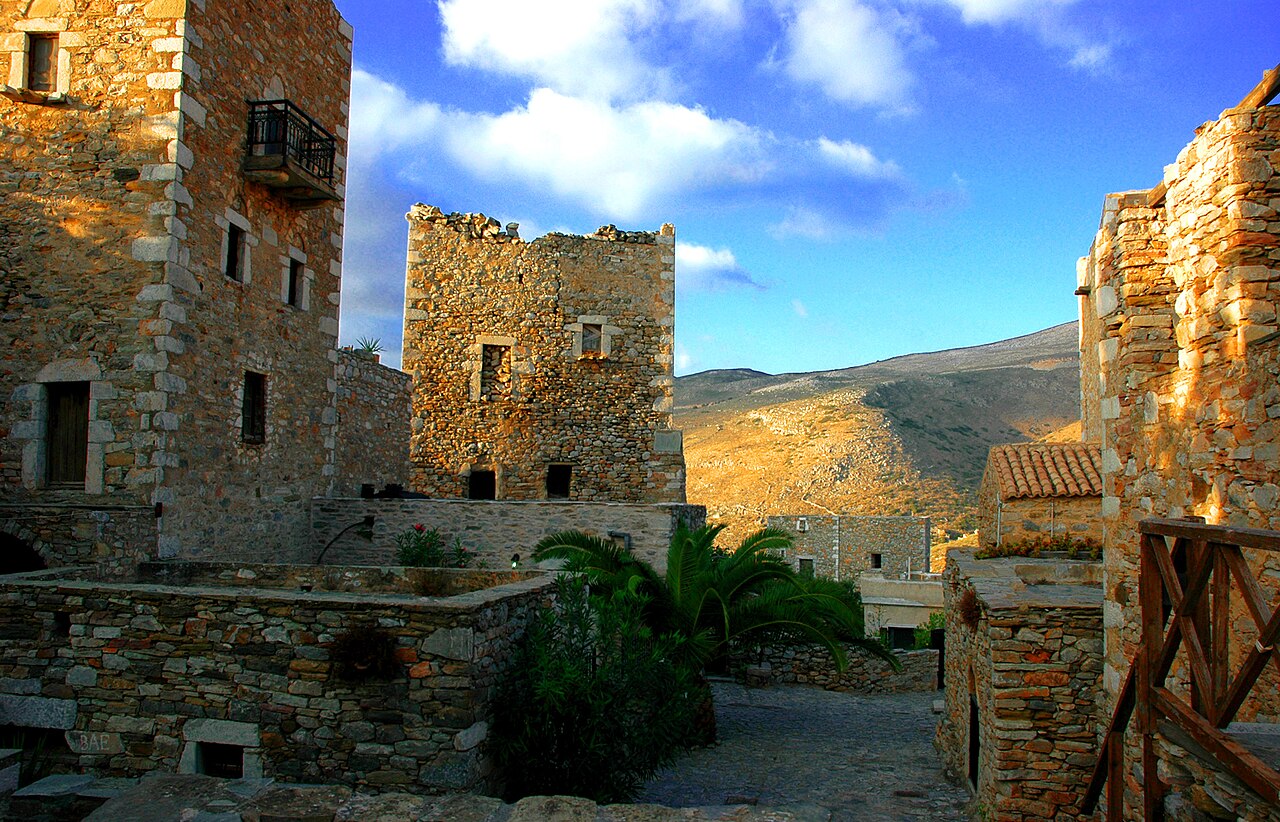
The towers of the Mani are not ruins left by some vanished empire. They are domestic architecture, built by farming families between roughly the 17th and 19th centuries, for a single clear reason: to survive their neighbours. Inner Mani's thin soil and scarce water meant land disputes were constant, and in a region with no reliable outside law, families settled matters themselves. A tower was a fortified house first and a status symbol second. The higher your tower stood above a rival clan's roofline, the clearer the message. Understanding why these structures exist tells you more about the Mani's character than any single monument can.
A land beyond the reach of empires
For most of its history, the Mani sat at the edge of whoever claimed to rule the Peloponnese. The Byzantines, the Franks after 1204, the Venetians, and later the Ottomans all held nominal authority over the peninsula's coastal fringe, but Inner Mani's barren, roadless interior was never fully subdued. Ottoman administrators largely left the Maniots to govern themselves in exchange for token tribute, a pragmatic arrangement given the terrain: narrow gorges, waterless plateaus, and villages reachable only by mule track until well into the 20th century. Without a central authority to enforce property lines or punish killings, communities relied on customary law and, when that failed, on the vendetta.
The logic of the vendetta tower
Mani's feuding system (gaida in some sources) operated on rules as rigid as any legal code. An insult, a boundary violation, or a killing obligated the offended family to respond, often years later, often against male relatives rather than the original culprit. Towers were the physical infrastructure of this system. Ground floors stored grain, oil, and animals; upper floors held living quarters reached by removable ladders or narrow internal stairs; and the top floor, the polemariko or "war floor," had slit windows for rifles and sometimes machicolations for dropping stones on anyone attempting to force the door. Some feuds between neighbouring towers lasted generations, with families literally building upward in response to a rival's new storey, since height determined firing angle and prestige alike. Villages like Vathia's cluster of towers show this arms race frozen in stone: a dozen fortified houses packed onto one outcrop, each trying to overlook the rest.
Materials, construction, and who built them
Towers were built from local schist and limestone, dry-stacked or bonded with a thin lime mortar, using techniques passed down through master builders rather than written plans. Walls at the base commonly reach 70 to 90 centimetres thick, tapering slightly as the tower rises, which is why many structures have survived two or three centuries of earthquakes with only partial collapse. A modest tower might stand 10 to 12 metres tall across three or four storeys; the largest, built by wealthier clans in villages such as Kitta or Vathia, exceeded 15 metres. Construction was a family and clan undertaking, sometimes taking years, and the cost in labour alone signalled a family's standing as clearly as the finished height.
Original tower houses show three visible features: a single ground-floor entrance (often the only door), slit windows that widen on the inside for a shooter's angle, and a top-floor overhang or corbelled projection used for defence. Later 19th-century additions, like balconies and larger windows, mark periods when feuding had eased.
Decline of the feud, rise of a landscape
The feuding economy began to fade after Greek independence in 1821, when Mani's clan leaders, including figures from the Mavromichalis family, played a prominent role in the revolution and gained recognition from the new Greek state. Centralised administration, courts, and eventually roads reduced the practical need for fortified houses, though vendettas persisted in isolated pockets into the early 20th century. Emigration, first to Athens and then abroad, emptied many tower villages by the mid-1900s, leaving the structures standing but unused. What saved them from demolition was largely neglect: there was no economic pressure to clear the stone, and the materials were too solid to easily reuse elsewhere. The result is a peninsula where you can still read three centuries of social history simply by walking between villages.
Where to see tower architecture today
Vathia remains the single best-preserved tower village, its silhouette visible from the approach road long before you reach it, and it rewards a visit at golden hour when the stone turns the colour of dried blood, fitting given the name locals sometimes give the region's history. Kitta, Nomia, and Flomochori hold smaller but authentic clusters, often with one or two towers restored as accommodation and others left as working shells. Areopoli itself, the historic gateway to Inner Mani, mixes tower houses with churches and merchant mansions, making it a good first stop for context before heading deeper; see our guide to Areopoli's stone villages for a walking approach. If you are planning a route that takes in several tower villages in sequence, the three-day Mani loop covers the main clusters without backtracking.
Practical notes for visiting
Most towers are privately owned and not open as museums; a handful in Vathia and Areopoli have small interpretive panels, and one or two in each major village have been converted into guesthouses where guests can experience the thick walls and narrow stairs firsthand. There is rarely an entry fee for simply walking through a tower village, though parking in Vathia is limited to a small area near the entrance. Spring (April to early June) and autumn (September to October) offer the clearest light for photographing the stone, while summer heat reflects hard off the walls by midday. If you want to base yourself near the towers rather than just pass through, our guide to where to stay in the Mani covers the trade-offs between a village room and a restored tower.
What makes Mani's towers worth the detour is not any single structure but the accumulation: village after village where ordinary houses once doubled as fortresses, built by people with no state to protect them and no choice but to protect themselves. The feuds ended generations ago. The stone did not forget.