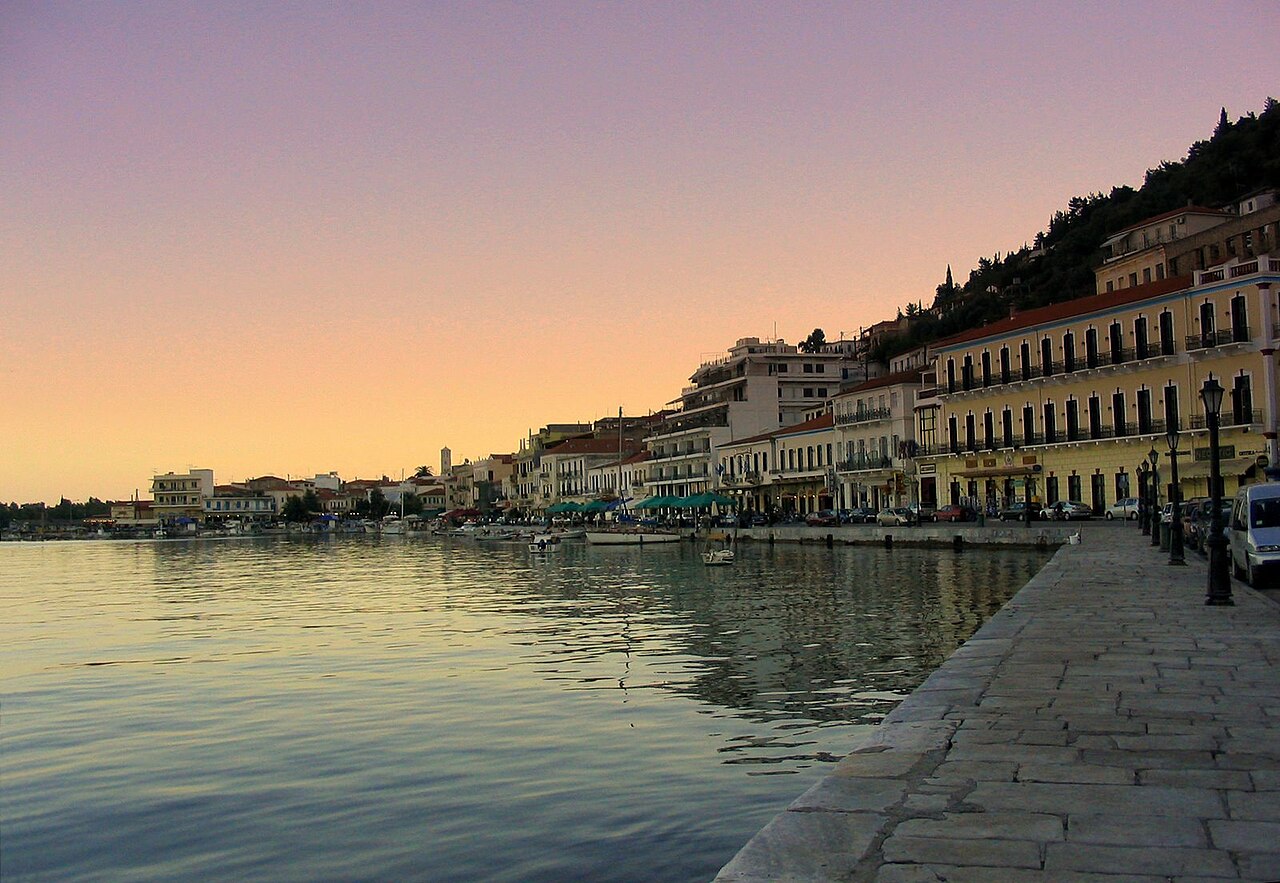
Gythio sits on the Laconian Gulf about 45 kilometers south of Sparti, its neoclassical houses stacked in ochre and rose above a curved harbor. For most visitors it is the last town with a traffic light before the Mani peninsula narrows into stone villages and tower houses, but it deserves more than a petrol stop. Fishing boats still unload here most mornings, the promenade fills with tavernas by evening, and a small tidal islet at the harbor's edge carries more mythology than its size suggests.
Getting your bearings in half a day
The town wraps around a natural harbor, with the main quay, Akti Vasileos Pavlou, running along the water for roughly 800 meters. Most of what matters sits within a 10-minute walk: the fish market near the port, a scattering of neoclassical facades climbing the hill behind, and the causeway out to Marathonisi islet. Walking the full waterfront loop, including a stop on the islet, takes about 45 minutes without pausing. Add another hour if you climb toward the old town for the view back over the gulf, where tiled roofs step down to the water in rows.
Marathonisi and the Menelaion legend
A short causeway, a few minutes' walk from the central quay, connects the mainland to Marathonisi, a small pine-covered islet long associated (in local tradition rather than firm archaeology) with the myth of Paris and Helen's departure for Troy. A restored tower on the islet, built in the 19th century, now houses a modest museum on the history of the Mani's seafaring and tower-building families; opening hours shift by season, so check the day's schedule locally rather than assume it is open. Even when the museum is closed, the walk out at golden hour is worth the detour: the water turns copper, and the Taygetos range behind town catches the last light.
Eating and the daily catch
Gythio's working fishing fleet means seafood here tends to be straightforward and fresh rather than elaborate. Expect grilled sardines, small fried fish, and octopus hung to dry on lines near the quay, often priced by the kilo and worth asking about before ordering. A plate of grilled fish for two with a salad and house wine typically runs somewhere in the 25 to 35 euro range, more if you choose larger fish sold by weight. For a broader sense of what to order across the region, including dishes you will see repeated in Mani kitchens further south, see this guide to traditional Maniot dishes.
Arrive before 10am if you want to see the fish market active and boats still unloading; by early afternoon the quay empties out and shifts into taverna mode.
Day trips and the road south
Gythio works well as a first or last night on a longer Mani itinerary, since it breaks the drive from Athens or Sparti before the roads narrow and climb into Inner Mani. From here it is roughly 45 minutes by car to Areopoli, the de facto capital of the stone villages, and closer to two hours if you continue to the peninsula's southern tip. Travelers piecing together a full route should look at the two-day Mani road trip for a structured plan starting from Areopoli, or the longer three-day loop if time allows a fuller circuit of the peninsula.
Practical notes on arrival and parking
Gythio is reachable by bus from Athens (via Sparti, roughly four hours total with a change) or by car via the Moreas motorway and then regional roads, a trip of about three and a half hours from central Athens. For a full comparison of options, including train and ferry alternatives, see every way to reach the Mani from Athens. Parking along the harbor fills quickly in July and August; the streets just above the quay, near the old town stairs, usually have space even at midday. If you are weighing whether to drive the Mani at all, the peninsula's roads are narrow and often single-lane near villages, so it is worth reading up on getting around without a car before committing to a rental.
When to visit
Spring (April to early June) and early autumn (September to mid-October) bring mild temperatures, working fishing boats, and far fewer visitors than peak summer. July and August are busiest, with higher prices for rooms and fuller tavernas, but also the liveliest evening atmosphere along the quay. Winter sees the town quieten considerably, though most core tavernas and at least one bakery near the market stay open year-round; for a sense of what else holds through the colder months across the wider region, the guide on Mani in winter covers what stays open. Whatever the season, if you plan to overnight before continuing south, the region's accommodation options are laid out in full on the where to stay guide, which compares Gythio-adjacent bases against Areopoli, Limeni, and Gerolimenas further into the peninsula.