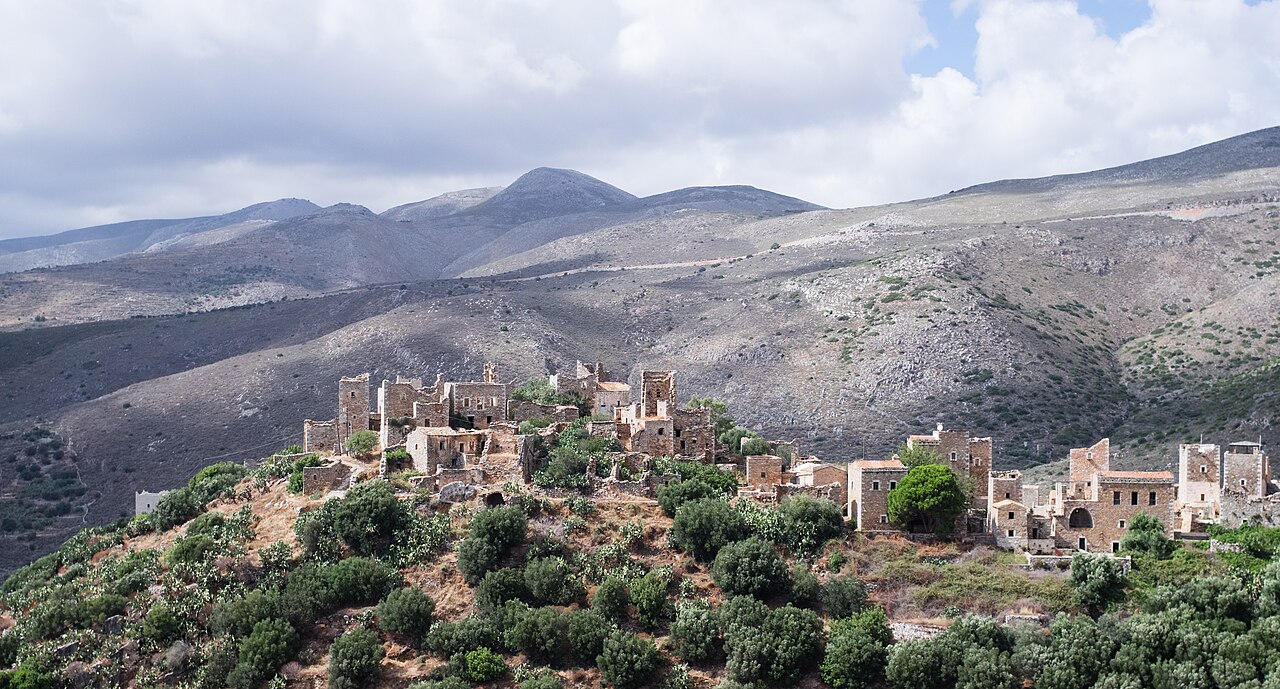
The Mani is not a place built for public transport. It is a narrow finger of limestone with villages scattered along a single ribbon of road that climbs, drops, and hairpins its way past olive terraces and tower houses. Ask anyone who has tried to string together a week here on foot and buses alone, and you will get the same answer: it is possible for a day or two, but it is not comfortable, and it will cost you the best parts of the peninsula. This guide lays out exactly why a car matters, what the alternatives actually look like, and where you can reasonably skip the rental.
Why distances deceive
On a map, the Mani looks compact. Areopoli to Gerolimenas is barely 20 kilometres. Gerolimenas to Vathia is another 8. But these are mountain roads, not motorway kilometres. Expect to average 30 to 40 km/h on the inner Mani routes, slower after dark or in wind. A drive that looks like 25 minutes on a GPS estimate often takes 40, especially through the single-lane stretches around Kitta or the switchbacks above Diros. The peninsula rewards slow travel, but slow only works if you control your own schedule, which a car allows and a bus timetable does not.
What public transport actually covers
KTEL buses connect Athens to Areopoli and on to Gerolimenas, usually once or twice a day depending on season, with service thinning sharply from November to March. Within the Mani itself, there is no regular local bus network linking the small villages: no scheduled service to Vathia, to the Diros Caves, or to the trailhead for Cape Tainaron. If your plan is to base yourself in one town and walk, Areopoli is the only place where enough is within reach on foot to make a car genuinely optional for a day or two. For the wider loop, you will be relying on the same bus that brought you in, which rarely runs more than once daily in each direction. For the full picture on reaching the region at all, see every way to reach the Mani from Athens.
Taxis, transfers, and what they cost
Taxis exist in Areopoli and Gerolimenas but are not metered the way city taxis are; agree a price before you get in. A one-way run from Areopoli to Vathia typically runs in the range of 20 to 30 euros depending on the driver and time of day, and there is no guarantee one will be waiting to bring you back. Pre-arranged transfers from Athens airport or Kalamata can be booked for specific dates, but they lock you into fixed arrival and departure points, which defeats much of the purpose of exploring a peninsula defined by small detours. Budget travellers should weigh these costs carefully; see what it really costs to visit the Mani for a fuller breakdown of transport versus rental spend.
Book a small or mid-size car, not an SUV. Village lanes in places like Vathia and Kitta narrow to barely a car's width, and parking is informal, often just a wider patch of verge. Automatic transmissions cost more to rent and are less common in local fleets, so book early if you need one.
Where you genuinely do not need a car
If your trip is built around a single base and short radius, you can skip the rental. Staying in Areopoli, you can walk to the old town's tower houses, reach the Diros Caves by taxi or occasional shuttle (check the day's schedule locally, as it is not fixed year-round), and arrange a boat trip without ever driving. The caves themselves are a case where logistics matter more than mobility; the full detail is in times, tickets and tactics for the Diros Caves. Hikers heading only to Cape Tainaron can sometimes combine a taxi drop at the trailhead with the walk itself, covered in the hike to Cape Tainaron. But these are narrow itineraries. The moment you want to see Vathia's abandoned towers, the stone beaches south of Gerolimenas, or more than one village a day, the car stops being a convenience and becomes the only practical option.
Planning a route around having a car
Most visitors who commit to renting build their days around two established routes. The first is a compact two-day version covering the essentials: see the two-day Mani road trip from Areopoli to the gate of Hades. Those with more time often prefer the slower three-day loop, which gives room to stop at viewpoints and stone beaches without rushing: the three-day loop that covers it all. Either way, choosing where to sleep matters as much as what you drive; a base in Limeni or Gerolimenas cuts driving time to the deep south compared to staying further north. Compare the options in where to stay in the Mani.
Seasonal considerations
Between July and September, roads are dry and reliable but parking in Areopoli's old town fills by mid-morning. From November to March, a few inner-Mani roads can be affected by rain damage or temporary closures after storms, and bus frequency drops further, making a car almost mandatory if you are travelling outside the main season. For a month-by-month breakdown of what to expect, consult the season-by-season guide to the Mani.
The verdict, in the end, is unromantic but accurate: the Mani's appeal lies precisely in the places a bus cannot reach, the towers at the end of a goat track, the beach below a ruined church, the taverna with no sign. A car does not just get you there faster. It is often the only way to get there at all.