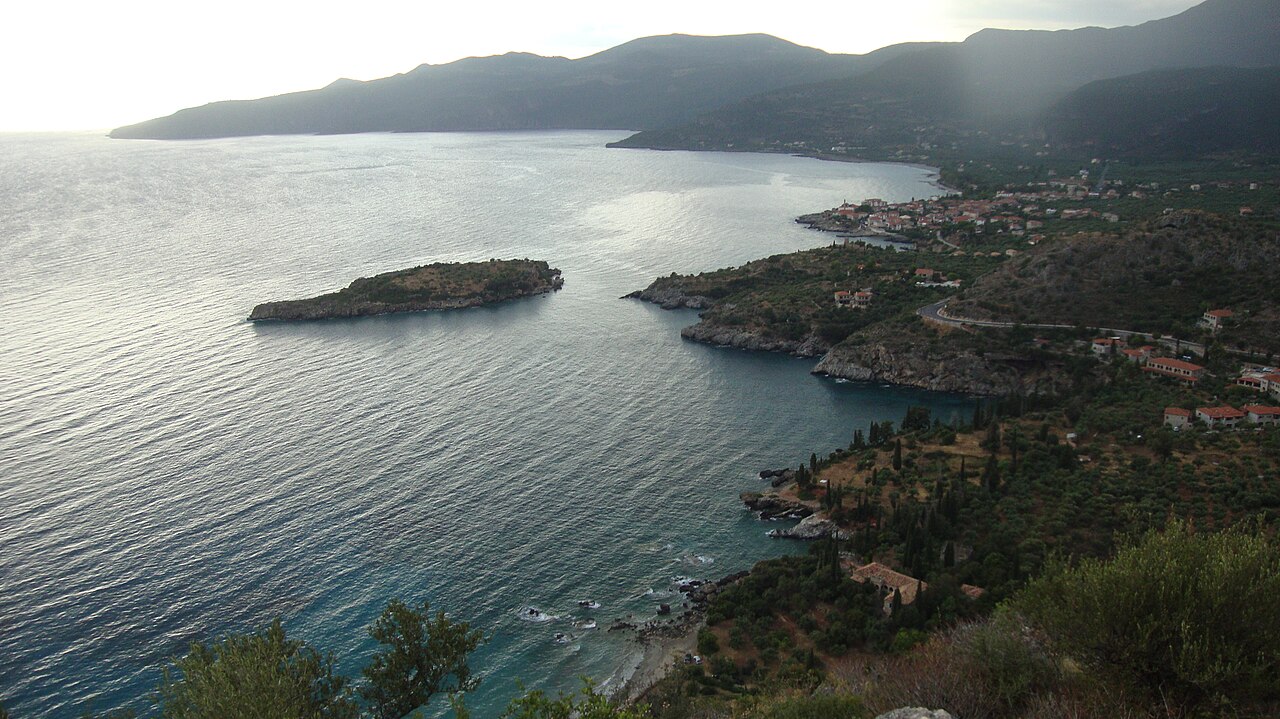
The Viros Gorge begins almost at the edge of Kardamyli, which is unusual for a canyon of this scale: most gorges in Greece ask for a drive before they ask for a climb. Here, you can finish breakfast in the village and be standing on riverbed stones within twenty minutes. The gorge cuts a deep, dry-stone wound through the western flank of the Taygetos range, and its trail is one of the few in the Mani that rewards walkers with shade, running water (seasonally) and genuine wilderness rather than sea views and sun.
Finding the trailhead
From the main square in Kardamyli, follow signs inland toward the Old Kardamyli settlement and the church of Agios Spyridon. A narrow lane climbs past the old tower houses and crosses a stone bridge, the Rindomo bridge, which most walkers use as the informal start of the gorge trail. There is no ticket booth, no gate and no fee: this is open countryside, waymarked in parts with red paint and old cairns rather than modern signage. Park near the Old Village, since the lane beyond narrows quickly and has nowhere sensible to turn around.
Route options and distances
Two broad options exist. The short loop follows the true left bank of the river for roughly 45 minutes to an hour, crossing the dry (or shallow) riverbed once or twice before climbing back out near the village of Petrovouni, a pleasant circuit of about 5 to 6 kilometres total. The long traverse continues deeper into the gorge toward the villages of Exochori or Tseria, a full crossing of the Taygetos foothills that takes most fit walkers 4 to 5 hours one way and requires a second car or a taxi arranged in advance for the return. Most visitors do the short loop; it delivers the gorge's best walls, overhangs and plane trees without the logistics of a one-way hike.
What the trail is actually like
Underfoot, expect smoothed limestone boulders, loose scree on the steeper banks and long stretches of dry riverbed that turn to a thin, clear stream after winter rain. The canyon walls rise in places to over 100 metres, pressing close enough that the path narrows to a scramble over rock rather than a maintained trail. There is no real exposure to vertigo, but ankles need attention: trainers are workable in dry late summer, proper hiking boots are the sensible choice the rest of the year. Shade is generous for a Mani walk, thanks to plane trees and the depth of the gorge itself, which keeps the air noticeably cooler than the coast even in July.
The riverbed can run with real water from late autumn through spring, sometimes enough to require a crossing above the ankle. Check conditions locally before heavy rain, and avoid the gorge entirely during or just after a storm, when flash flooding through the narrows is a genuine risk.
Best season and time of day
Spring, from April to early June, is the strongest season: wildflowers line the banks, the stream still runs, and temperatures stay comfortable for a 1 to 2 hour walk. Autumn, September into November, offers a drier bed but cooler air and good light. Summer is workable because of the shade, but start early, by 8am at the latest, to avoid the worst heat on the exposed approach sections near the trailhead. For light and photography, the gorge's narrow walls mean full sun only reaches the riverbed around midday, so early morning and late afternoon bring a softer, more atmospheric gloom to the stone.
What to bring
Sturdy footwear with grip, at least one litre of water per person for the short loop and more for the long traverse, a sunhat for the exposed start and end sections, and a basic first-aid kit, since phone signal disappears quickly once the walls close in. Walking poles help on the loose scree sections. There are no facilities, cafes or water refill points inside the gorge itself, so plan accordingly before you leave the village. Those staying longer in the area often pair this hike with a day at the Mani's best stone beaches for an easy contrast of canyon and coast within the same afternoon.
Combining the gorge with a wider Mani visit
Kardamyli works well as a base for several days, not just the gorge: the village itself has old tower houses, a working harbour and a strong restaurant scene, covered in detail in our local's guide to Kardamyli. If the gorge is one stop among several, it slots naturally into a longer loop through the peninsula, such as the route outlined in our three-day Mani road trip loop, which takes in the tower villages and southern capes beyond. For sleeping options near the trailhead itself, see our guide to where to stay in the Mani, which covers Kardamyli alongside Areopoli, Limeni and Gerolimenas.
A note on respect for the terrain
The Viros Gorge is not managed in the way a national park trail would be: there is no ranger station, no rescue infrastructure beyond local knowledge, and conditions can shift quickly after rain. Walkers should tell someone their planned route and expected return time, carry a charged phone even where signal is patchy, and turn back without hesitation if the stream rises or the sky darkens. The gorge rewards a cautious approach: it has stood, cut stone by stone through the Taygetos limestone, for far longer than any trail marker, and it asks only that visitors move through it with the same patience.